
Why We're Not Roman Catholic #5 - The Mass Is Not the Gospel
- Oct 9, 2025
- 4 min read
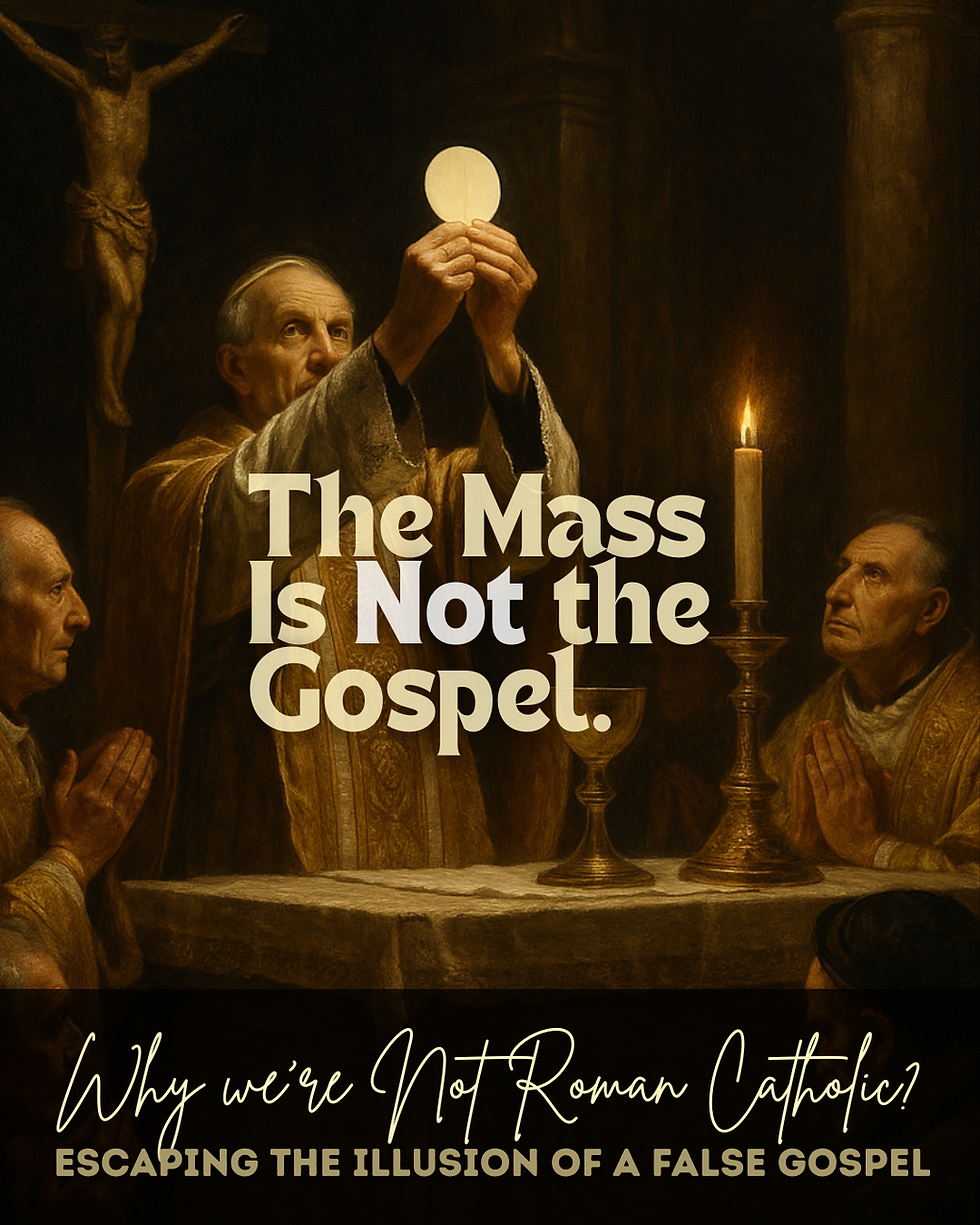
One of the common accusations from Roman Catholics against Protestants is that we don’t have true worship. The reason they say this is because, in their view, true worship demands an actual sacrifice, and for that reason, the "holy Mass" is, according to them, the only form of true Christian worship. The Roman Church explicitly teaches that the Mass is not merely a memorial of Christ’s sacrifice, but an actual sacrificial offering that atones for sin. Their priests are invested with the authority to perform this eucharistic sacrifice. As they consecrate the bread and the wine, these elements become the actual body and blood of Christ through a process called transubstantiation, and are then offered on the altar before God.
Now, this is not a criticism to be taken lightly, and we Protestants would do well to seriously assess whether the Roman Catholic position holds true. As Christians, we should have an ardent desire to offer God the kind of worship that pleases Him. So we’ll consider this in two parts. In this article, I’ll explain why the Roman Mass re-presents Christ’s sacrifice in a way that undermines the sufficiency of His work. In the next article, we’ll explore transubstantiation more deeply and examine what is actually happening during the Lord’s Supper (or Holy Communion).
The first thing to understand is that the Roman Church teaches explicitly that the Mass is a true sacrificial offering that atones for sin:
“The sacrifice of Christ and the sacrifice of the Eucharist are one single sacrifice... the sacrifice is truly propitiatory.” — Catechism of the Catholic Church (CCC) 1367
“If anyone says that the sacrifice of the Mass is only a sacrifice of praise and thanksgiving… and not a propitiatory sacrifice... let him be anathema.” — Council of Trent, Session 22, Canon 3
Rome teaches that each Mass re-presents the sacrifice of Calvary in an unbloody manner and applies its merits to the faithful:
“In this divine sacrifice which is celebrated in the Mass, that same Christ is contained and immolated in an unbloody manner...” — Council of Trent, Session 22, Chapter 2
Many Protestants—especially evangelicals—tend to get uncomfortable with sacrificial language and, for this reason, avoid the entire conversation. But historically, Protestants have affirmed that there is a sense in which we can speak of the Lord’s Supper as a kind of sacrifice—a sacrifice of praise and thanksgiving. What Protestants have always rejected, however, is the idea of a propitiatory sacrifice—something that atones for sin. That’s what the Council of Trent reacted against and anathematized.
In Roman theology, while the cross is central, its benefits are not seen as fully secured and applied through faith once for all, but must be continually applied through the Mass.
This teaching stands in direct contradiction to the Book of Hebrews, which emphasizes over and over that Christ’s sacrifice was once for all time and never to be repeated:
“But when Christ had offered for all time a single sacrifice for sins, he sat down at the right hand of God…” — Hebrews 10:12
“For by a single offering he has perfected for all time those who are being sanctified.” — Hebrews 10:14
“Nor was it to offer himself repeatedly… but as it is, he has appeared once for all at the end of the ages to put away sin by the sacrifice of himself.” — Hebrews 9:25–26
The Romanist repetition of sacrifices—daily, weekly, and over a lifetime—is not a continuation of the Gospel, but a return to the shadows of the old covenant system.
Furthermore, by making forgiveness, justification, and sanctification (in other words, salvation) dependent on repeated acts of sacramental participation, the Roman system keeps people under a burden of guilt. There’s no finish line. No full assurance. The Mass becomes a means of keeping sin manageable rather than declaring it truly forgiven—fully paid for—and proclaiming that the believer is truly saved from the judgment and wrath to come.
The assurance that Rome offers is a false assurance, dependent on human obedience, human mediators (priests), and a counterfeit grace dispensed even apart from faith and on the basis of merit—a concept blatantly contrary to the teaching of Scripture.
It is true that evangelical worship today is often impoverished—lacking weight, reverence, and transcendence. But the answer to that poverty is not Rome. It is not in the Mass. The answer is found in the rich, biblical, and gospel-centered worship recovered in the Reformation.
To say that the Mass is necessary for the ongoing forgiveness of sins is to deny the sufficiency of Christ's finished work. The Mass is not a reverent continuation of Christ’s ministry—it is a theological error that places a priest between the believer and Christ and undermines the very heart of the Gospel.
If you are hungry for deeper, more meaningful worship, Rome will only offer you a different burden—not freedom. The true answer is to return to what the Protestant Reformation brought into the light: worship that flows from the pages of Scripture, offered by a people whose hearts have been transformed by the power of the Gospel.
May God be gracious to His people, sanctifying them by His Word and Spirit, so that they may offer themselves as living sacrifices—holy, acceptable, and pleasing in His sight.
Nino Marques


Comments